
The world of work has entered a new era. From the rise of hybrid work models to the adoption of advanced HR technology trends in 2026, organizations are rapidly reshaping how they manage people, payroll, and performance. For HR leaders, the coming year is not only about managing change but also about reimagining the future of human resources.
This blog explores the most important HR trends 2026, the challenges and opportunities facing HR professionals, and what every organization should prioritize to stay competitive in a rapidly evolving global workforce.
Why Workforce Management Is Evolving in 2026
Workforce management has always been about ensuring the right people are in the right roles at the right time. But in 2025, three powerful forces are accelerating change:
-
Technology Disruption
AI, automation, and analytics are changing how HR manages talent. -
Shifts in Work Models
The balance of remote, hybrid, and on-site work continues to evolve. -
Employee Expectations
Today’s employees demand flexibility, purpose, and well-being support.
74% of employees want more flexible work options, and 61% of CEOs are investing in new HR technologies. Supporting workforce changes.
— PwC’s 2024 Future of Work SurveyTop HR Trends 2026 Every Leader Should Watch
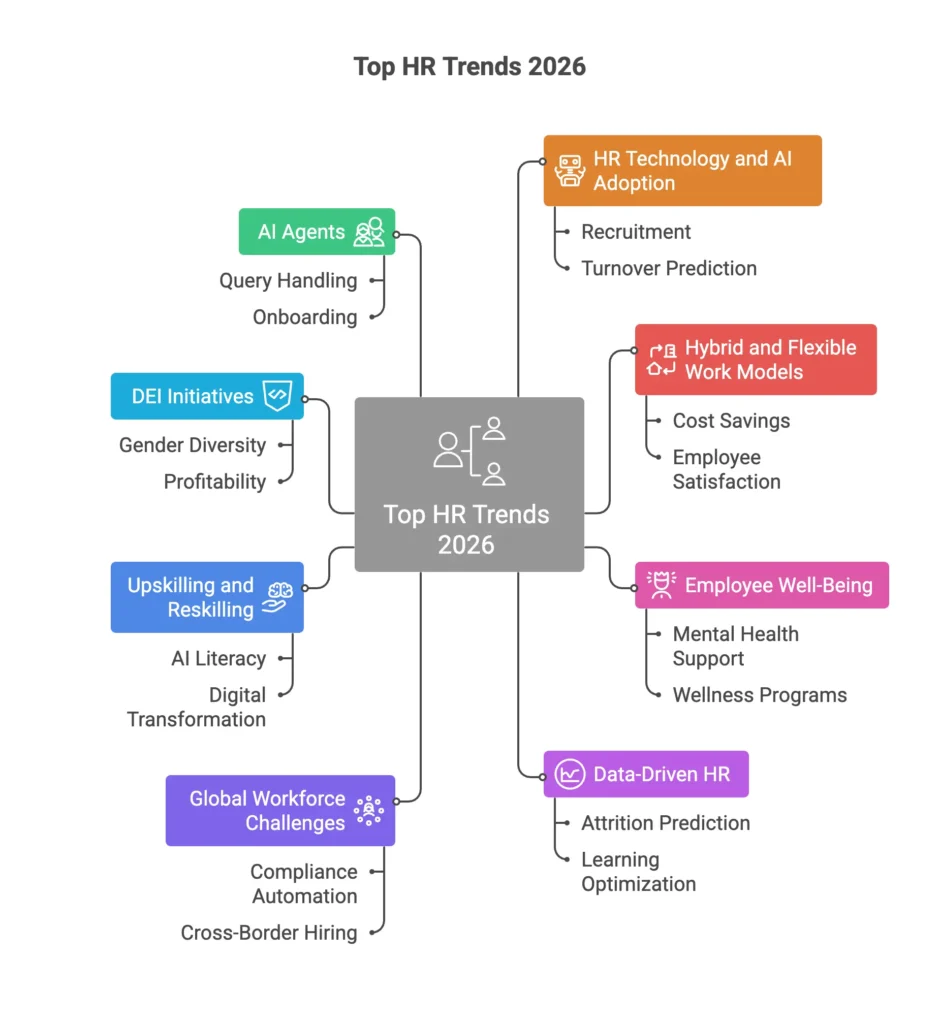
HR Technology and AI Adoption
The most talked-about HR technology trends of 2025 revolve around AI-powered solutions, automation, and predictive analytics. HR leaders are now leveraging AI for:
- Recruitment and resume screening
- Predicting turnover risks
- Personalized employee training paths
- Payroll accuracy and compliance
"Gartner predicts that by 2025, 50% of HR departments will use AI-driven tools to manage at least one core HR function."
Hybrid and Flexible Work Models
The debate over remote vs. in-office work has evolved into a balanced hybrid working model. Employers are redesigning policies to ensure productivity while respecting employee flexibility.
Benefits of the hybrid model include:
- Cost savings on office spaces
- Increased employee satisfaction
- Expanded talent pools (hiring beyond geography)
This makes the future of HR less about enforcing policies and more about building trust and flexibility.
Employee Well-Being as a Core HR Priority
Well-being is no longer a perk; it’s a core HR priority. Companies are investing in mental health support, wellness programs, and work-life balance initiatives.
A Deloitte Global Human Capital report found that 77% of employees consider wellness programs a deciding factor when choosing an employer.
For HR leaders, supporting mental health will be as important as offering competitive salaries.
Data-Driven HR and People Analytics
One of the fastest-growing human resources trends for 2026 is the use of advanced analytics to inform workforce decisions. From predicting employee attrition to optimizing learning & development, HR teams are relying on data to be more strategic.
Example: A retail company using people analytics reduced employee turnover by 20% by identifying early warning signs of disengagement.
Global Workforce and Compliance Challenges
With more companies hiring remote employees globally, HR leaders face new complexities in payroll, taxes, and compliance. This results in HR goals being heavily focused on global HR policies, cross-border hiring, and compliance automation.
"A Mercer survey revealed that 59% of CHROs consider global compliance one of their top three workforce challenges in 2025."
Upskilling and Reskilling as Strategic Priorities
The rapid pace of technological change is creating new skills gaps. One of the top 5 priorities for HR leaders in 2026 will be ensuring employees have the right skills for the future.
Emerging initiatives include:
- AI literacy programs
- Digital transformation workshops
- Leadership training for hybrid team management
The World Economic Forum predicts that 50% of employees will need reskilling by 2025 to remain competitive in the labor market.
— Future of Jobs TrendsDiversity, Equity, and Inclusion (DEI) in Action
Human resources priorities in 2026 will also include DEI initiatives, not just as compliance requirements but as drivers of innovation. Organizations with diverse leadership teams consistently outperform those without.
Example: McKinsey research shows that companies in the top quartile for gender diversity are 25% more likely to achieve above-average profitability.
HR in the Age of AI Agents
Beyond traditional software, future HR trends include the rise of AI agents, virtual HR assistants that can handle queries, onboard new hires, and manage employee requests 24/7.
For HR teams, this means more time to focus on strategic change management trends, rather than being bogged down by administrative tasks.
Payroll Innovation and Blockchain Adoption
Payroll is no longer just about cutting checks. With the rise of global workforces, companies are adopting:
- Blockchain-based payroll systems
- On-demand pay (access to earned wages instantly)
- Digital wallet integration
These emerging HR trends are expected to ensure employees are paid securely and promptly, regardless of location.
Leadership Redefined
Emerging leadership trends show that command-and-control styles are being replaced with empathetic, collaborative leadership. HR will play a vital role in developing leaders who can manage distributed teams, foster inclusivity, and drive innovation.
Current HR Trends and Challenges
While there are several things to discuss, many of today’s challenges carry over:
- Talent shortages in tech, healthcare, and digital roles
- Balancing flexibility with productivity
- Managing multi-generational teams (Gen Z to Boomers)
- HR’s role in sustainability and ESG reporting
According to SHRM, 63% of HR professionals cite talent acquisition as their biggest challenge going into 2025.
— Talent Acquisition TrendsHR Goals for 2026: What Leaders Should Prioritize
Here are the top HR goals for 2026 that organizations must set:
- Embrace HR tech trends and invest in automation.
- Support hybrid work models with strong policies.
- Elevate employee experience through well-being initiatives.
- Invest in learning & development for digital skills.
- Ensure compliance with global HR regulations.
The Future of Human Resources
So, is human resources over? Absolutely not. Instead, it’s evolving into a more strategic, data-driven, and technology-enabled function. The future of human resources will see HR leaders acting as:
- Change architects
- Employee experience champions
- Technology adopters
- Business growth partners
Conclusion
Workforce management trends in 2025 highlight a transformation driven by technology, flexibility, and employee-first strategies. For HR leaders, this is a defining moment: adapt and lead, or risk falling behind. By embracing HR technology trends in 2026, prioritizing well-being, and aligning with global workforce realities, HR can move from being an administrative function to a true driver of organizational success.
FAQs
What are the top HR trends for 2026?
The biggest include AI adoption, hybrid work models, employee well-being, payroll innovation, and data-driven HR.
What are the top 5 priorities for HR leaders in 2026?
Investing in HR tech, reskilling employees, enhancing DEI, supporting hybrid models, and ensuring global compliance.
What are the HR goals for 2026?
Core goals include supporting employee well-being, leveraging technology, and reskilling the workforce for future needs.
How will HR technology trends 2026 impact businesses?
AI, automation, and analytics will make HR more efficient, reduce errors, and provide data-driven insights.
What are the biggest HR challenges in 2026?
Talent acquisition, compliance in global hiring, and balancing employee flexibility with organizational productivity.
Is human resources over in 2026?
No, but HR is transforming into a strategic business partner driven by technology and people-centric policies.
How will leadership change in 2026?
Emerging leadership trends emphasize empathy, collaboration, and inclusivity over traditional authority-based models.